Getting you a comprehensive review of the product
Reading every ingredient in the formula…

Getting you a comprehensive review of the product
Reading every ingredient in the formula…
Join The Clean Sheet™ community
Science-backed beauty tips, ingredient alerts, and early access. Straight to your WhatsApp.
Join for free →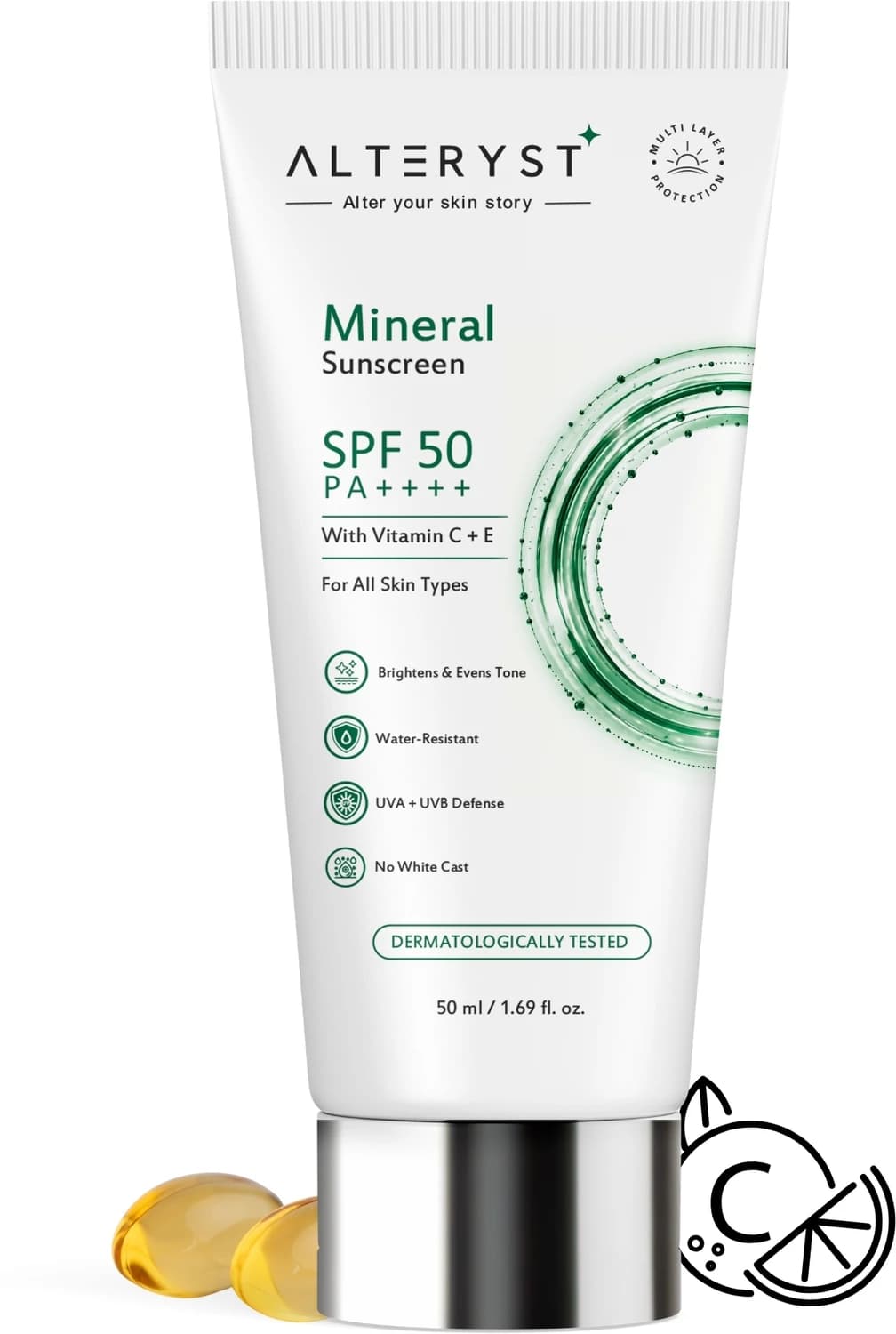
This Alteryst Mineral Sunscreen promises robust sun protection with key antioxidants, but its high claims for brightening and anti-ageing outrun the visible evidence, and the lack of a full ingredient list significantly hinders transparency for the discerning consumer.
₹299 • Analysed 11 October 2026
This Alteryst Mineral Sunscreen is positioned as a high SPF (50 PA+++) option suitable for Indian conditions, claiming no white cast and water resistance, which are crucial for humid climates and active lifestyles. The inclusion of Vitamin C and E aligns with consumer demand for brightening and antioxidant benefits, especially relevant for Fitzpatrick III-V skin types prone to hyperpigmentation. The pricing is competitive, particularly at the discounted rate on the brand's website. However, the lack of a full INCI list is a significant transparency gap for the Indian consumer, who is increasingly ingredient-aware.
Independent and free. The Clean Sheet takes no money from brands to review, rank, or approve a product. This is a web evidence review, not a Clean Sheet certification. We checked the ingredient list, publicly available test reports, marketing claims, and formula logic using only public information available at the time of review.
Claimed actives Vitamin C, Vitamin E, and Zinc Oxide (22% Micronized Zinc Oxide) are mentioned on multiple platforms. However, a full INCI list is not publicly available to confirm all ingredients and their exact forms/concentrations. The 'mineral' claim is supported by the stated Zinc Oxide percentage.
SPF 50 and PA+++/PA++++ ratings are consistently claimed. While no specific ISO 24444 or equivalent test report is publicly visible for this exact product, SPF claims are standard for sunscreens. The presence of 22% Zinc Oxide supports the SPF claim for a mineral sunscreen.
A general suitability claim, not requiring specific evidence beyond formulation for broad use. No specific gender-limiting ingredients are implied.
Attributed to Vitamin C. Vitamin C is known for brightening properties, but this is ingredient-level evidence. No finished product study is publicly visible to confirm this specific product's brightening effect.
Claimed on multiple platforms. The use of 'Micronized Zinc Oxide' (22%) is a formulation strategy to minimize white cast in mineral sunscreens. This is a common claim for modern mineral sunscreens, and the formulation choice supports it.
Claimed on multiple platforms. Water resistance requires specific testing (e.g., 40 or 80 minutes). While no test report is visible, this is a performance claim that implies finished product testing.
A sensory claim. The use of 'Micronized Zinc Oxide' is intended to contribute to a lighter feel compared to traditional zinc oxide. This is plausible based on modern mineral sunscreen formulations.
A sensory claim. Formulations with micronized zinc oxide often aim for a non-greasy finish. This is plausible based on common formulation goals for sunscreens.
What we could confirm from public sources and the verified ingredient list.
Irritation & Allergen Risk
Brand states a patch test (HRIPT) was performed.
Brand claims dermatologist testing (claim stated; underlying report not seen).
Ingredient Transparency
Active percentages are disclosed for the hero ingredient(s).
Standards & Compliance
Usage warnings and directions are clear on the label.
Screened against a curated reference set that we are continuing to verify and expand, so “clear” means no flag from that set, not a guarantee. Not a substitute for a full toxicological or clinical assessment.
| Ingredient |
|---|
INCI order as declared on packaging. Position reflects approximate concentration (high to low).
No prohibited or restricted ingredients identified (based on claimed actives)
No prohibited or restricted ingredients identified (based on claimed actives)
No prohibited or restricted ingredients identified (based on claimed actives)
No prohibited or restricted ingredients identified (based on claimed actives)
No prohibited or restricted ingredients identified (based on claimed actives)
No prohibited or restricted ingredients identified (based on claimed actives)
No prohibited or restricted ingredients identified (based on claimed actives)
No prohibited or restricted ingredients identified (based on claimed actives)
No prohibited or restricted ingredients identified (based on claimed actives)
No prohibited or restricted ingredients identified (based on claimed actives)
Flags are based on publicly available INCI only. Not a substitute for full regulatory compliance review.
Claimed actives Vitamin C, Vitamin E, and Zinc Oxide (22% Micronized Zinc Oxide) are mentioned on multiple platforms. However, a full INCI list is not publicly available to confirm all ingredients and their exact forms/concentrations. The 'mineral' claim is supported by the stated Zinc Oxide percentage.
Mentioned only
SPF 50 and PA+++/PA++++ ratings are consistently claimed. While no specific ISO 24444 or equivalent test report is publicly visible for this exact product, SPF claims are standard for sunscreens. The presence of 22% Zinc Oxide supports the SPF claim for a mineral sunscreen.
Evidence visible
A general suitability claim, not requiring specific evidence beyond formulation for broad use. No specific gender-limiting ingredients are implied.
Missing
Attributed to Vitamin C. Vitamin C is known for brightening properties, but this is ingredient-level evidence. No finished product study is publicly visible to confirm this specific product's brightening effect.
Mentioned only
Claimed on multiple platforms. The use of 'Micronized Zinc Oxide' (22%) is a formulation strategy to minimize white cast in mineral sunscreens. This is a common claim for modern mineral sunscreens, and the formulation choice supports it.
Evidence visible
Claimed on multiple platforms. Water resistance requires specific testing (e.g., 40 or 80 minutes). While no test report is visible, this is a performance claim that implies finished product testing.
Evidence visible
A sensory claim. The use of 'Micronized Zinc Oxide' is intended to contribute to a lighter feel compared to traditional zinc oxide. This is plausible based on modern mineral sunscreen formulations.
Mentioned only
A sensory claim. Formulations with micronized zinc oxide often aim for a non-greasy finish. This is plausible based on common formulation goals for sunscreens.
Mentioned only
This implies 'non-comedogenic'. No specific non-comedogenic testing data is publicly visible. However, mineral sunscreens are generally considered less likely to clog pores than some chemical filters.
Missing
Mineral sunscreens (Zinc Oxide) are generally recommended for sensitive skin. Suitability for oily skin and humid conditions depends on the full formulation, which is not available.
Mentioned only
Public evidence the brand could provide to close verification gaps
This review evaluates brand claims against visible evidence and formula logic. It does not replace a full ingredient safety analysis or a clinical product test. Results vary by individual, and the consumer should always read the full ingredient list and follow usage guidance.
Are you the brand? If you have published test data or want to request a re-review, write to us at hello@thecleansheet.in.
