Getting you a comprehensive analysis of the product
Reading every ingredient in the formula…
Getting you a comprehensive analysis of the product
Reading every ingredient in the formula…
Join The Clean Sheet™ community
Science-backed beauty tips, ingredient alerts, and early access. Straight to your WhatsApp.
Join for free →
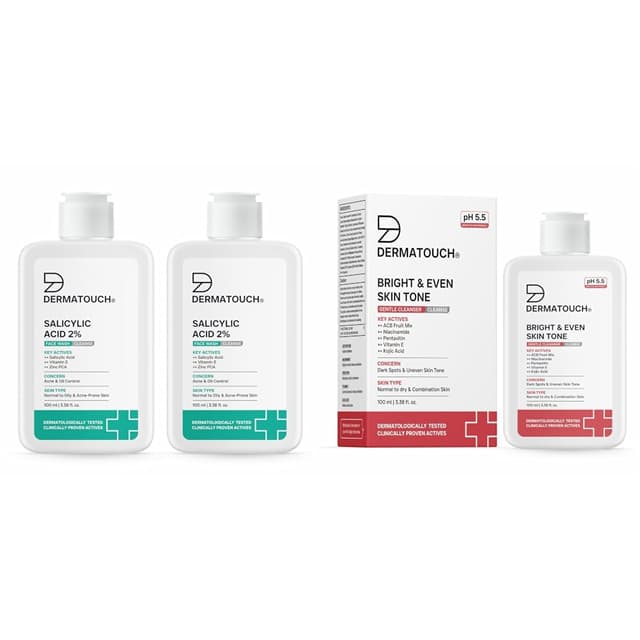
This Dermatouch face wash offers a targeted approach for oily and acne-prone skin with well-known actives, but its claims of bacterial combat, coupled with the presence of Triclosan, warrant regulatory scrutiny and careful consumer consideration.
₹90 • Analysed 22 October 2026
This Dermatouch face wash is positioned for the common Indian concern of oily and acne-prone skin, which is exacerbated by India's humid climate. The inclusion of Salicylic Acid and 'AcneBusters' (botanical extracts) aligns with consumer preference for active ingredients. The price point is competitive, especially with discounts on marketplaces, making it accessible. However, the presence of Triclosan and claims of 'combat acne-causing bacteria' raise a potential drug boundary risk under Indian regulations if the product is not licensed as a drug for such therapeutic claims. Consumers should be aware of the ingredient Triclosan and its regulatory status.
Independent and free. The Clean Sheet takes no money from brands to analyse, rank, or approve a product. This is a web evidence analysis, not a Clean Sheet certification. We checked the ingredient list, publicly available test reports, marketing claims, and formula logic using only public information available at the time of analysis.
Product positioning and ingredient profile (Salicylic Acid, AcneBusters, Triclosan) generally support these functional and concern-based claims.
Claim is made consistently across platforms. pH balance is a formulation choice that can be verified by the brand.
Ingredient profile (Salicylic Acid, Triclosan, Zinc PCA, AcneBusters) is suitable for these skin types.
Both Salicylic Acid and the complex of botanical extracts (AcneBusters) are listed in the INCI.
Salicylic Acid is known for its ability to penetrate oil and exfoliate within pores (ingredient-level evidence). As a rinse-off product, the 'deeply' aspect is ambitious without finished product testing.
Salicylic Acid and Triclosan have antimicrobial properties (ingredient-level evidence). As a rinse-off product, the efficacy of 'reducing impurities' to prevent acne needs finished product validation.
Surfactants (Sodium Laureth Sulfate, Cocamidopropyl Betaine) and Salicylic Acid are effective at oil removal. The 'gentle' claim is supported by the pH-balanced nature and hydrating ingredients.
This is a well-established property of Salicylic Acid (ingredient-level evidence). The 'prevent breakouts' claim is ambitious for a rinse-off product without finished product clinical data.
What we could confirm from public sources and the verified ingredient list.
Ingredient Safety & Toxicity
Full ingredient list retrieved and verified against the label.
Brand describes ingredient origin in its claims.
Screened against the ingredient database (3 of 12 ingredients matched); no cosmetics-prohibited ingredient found.
triclosan: Antimicrobial with endocrine-activity concern; tightly restricted.
No IARC-classified or formaldehyde-releasing ingredient found in the database screen.
No commonly-comedogenic ingredient found - a reasonable fit for acne-prone skin.
Irritation & Allergen Risk
Fragranced, but individual allergens are hidden behind 'Parfum' rather than declared.
No high-sensitisation preservative (MI/MCI/formaldehyde-releaser) from our screen was found.
Built on a stronger sulphate surfactant (sodium laureth sulfate) - effective, but can feel stripping on sensitive skin or in hard water.
Brand claims dermatologist testing (claim stated; underlying report not seen).
Ingredient Transparency
The full INCI list is publicly available, not just hero ingredients.
Any proprietary 'complex' is broken down into its actual ingredients.
Ingredients are listed in the descending order required by India Cosmetics Rules 2020.
Standards & Compliance
Usage warnings and directions are clear on the label.
Screened against a curated reference set that we are continuing to verify and expand, so “clear” means no flag from that set, not a guarantee. Not a substitute for a full toxicological or clinical assessment.
| Ingredient |
|---|
Aqua |
Sodium Laureth Sulfate |
Cocamidopropyl Betaine |
Acrylates/C10-30 Alkyl Acrylate Crosspolymer |
Glycine Soja (Soybean) Seed Extract (and) Houttuynia Cordata Extract (and) Scutellaria Baicalensis Root Extract (and) Melia Azadirachta Leaf Extract (and) Rehmannia Chinensis Root Extract (and) Salix Alba (Willow) Bark Extract (and) Phellodendron Amurense Bark Extract (and) Lactobacillus/Pear Juice Ferment Filtrate |
Aloe Barbadensis Extract |
Salicylic Acid |
Cellulose Beads |
Phenoxyethanol (and) Ethylhexylglycerin |
Sodium Hydroxide |
D-Panthenol |
Triclosan |
Fragrance (IFRA Certified) |
INCI order as declared on packaging. Position reflects approximate concentration (high to low).
Triclosan is restricted in the EU (Annex V, max 0.3% in rinse-off products). Its presence requires careful formulation and adherence to limits. Fragrance allergens would need to be declared if present above thresholds.
Triclosan is permitted in India (Schedule S, max 0.3% in rinse-off products). However, claims of 'combat acne-causing bacteria' in conjunction with Triclosan could trigger drug classification if not appropriately licensed.
Triclosan is on the Hotlist with concentration restrictions.
Triclosan is generally not recognized as safe and effective for consumer antiseptic washes by the FDA. Its use in this context would be a concern in the US market.
No prohibited or restricted ingredients identified.
No prohibited or restricted ingredients identified.
No prohibited or restricted ingredients identified.
No prohibited or restricted ingredients identified.
Triclosan is restricted in Australia.
No prohibited or restricted ingredients identified.
Flags are based on publicly available INCI only. Not a substitute for full regulatory compliance assessment.
“Helps reduce acne-causing impurities”
The presence of Triclosan, an antibacterial agent, combined with claims of 'reducing acne-causing impurities' and 'combat acne-causing bacteria' could push this product into drug territory under India's Drugs & Cosmetics Act if not appropriately licensed for such claims. Triclosan is a regulated ingredient.
“AcneBusters combines the strength of Houttuynia Cordata, Melia Azadirachta (Neem), Salix Alba (Willow Bark),…”
The claim to 'combat acne-causing bacteria' combined with the presence of Triclosan in the INCI raises a drug boundary risk under India's Drugs & Cosmetics Act if the product is not licensed as a drug for such therapeutic claims.
Product positioning and ingredient profile (Salicylic Acid, AcneBusters, Triclosan) generally support these functional and concern-based claims.
Mentioned only
Claim is made consistently across platforms. pH balance is a formulation choice that can be verified by the brand.
Evidence visible
Ingredient profile (Salicylic Acid, Triclosan, Zinc PCA, AcneBusters) is suitable for these skin types.
Mentioned only
Both Salicylic Acid and the complex of botanical extracts (AcneBusters) are listed in the INCI.
Mentioned only
Salicylic Acid is known for its ability to penetrate oil and exfoliate within pores (ingredient-level evidence). As a rinse-off product, the 'deeply' aspect is ambitious without finished product testing.
Mentioned only
Salicylic Acid and Triclosan have antimicrobial properties (ingredient-level evidence). As a rinse-off product, the efficacy of 'reducing impurities' to prevent acne needs finished product validation.
Mentioned only
Surfactants (Sodium Laureth Sulfate, Cocamidopropyl Betaine) and Salicylic Acid are effective at oil removal. The 'gentle' claim is supported by the pH-balanced nature and hydrating ingredients.
Mentioned only
This is a well-established property of Salicylic Acid (ingredient-level evidence). The 'prevent breakouts' claim is ambitious for a rinse-off product without finished product clinical data.
Mentioned only
The complex is listed in the INCI. However, the specific efficacy of this complex in *this finished product* to 'combat acne-causing bacteria' and 'calm inflammation' is ingredient-level evidence (Level 2) without finished product testing.
Mentioned only
D-Panthenol (Pro-Vitamin B5) is a known humectant and skin conditioner, present in the INCI. This claim is well-supported by ingredient function.
Mentioned only
Public evidence the brand could provide to close verification gaps
This analysis evaluates brand claims against visible evidence and formula logic. It does not replace a full ingredient safety analysis or a clinical product test. Results vary by individual, and the consumer should always read the full ingredient list and follow usage guidance.
Are you the brand? If you have published test data or want to request a re-analysis, write to us at hello@thecleansheet.in.