Consumer Safety
9 min read
How to Verify Beauty Product Claims Before You Buy
September 21, 2026Read
A serum's “2% complex”, a “fragrance free” label sitting beside parfum, a mist with “no preservatives”. Each raises a different question. Here are five red flags worth checking on an ingredient list before you buy, and what to ask when the answer stays unclear.
A serum advertises “2% ceramide complex”. A moisturiser says “fragrance free”, but its ingredient list includes parfum. A face mist promises a long shelf life with “no preservatives”.
These labels raise different questions. One needs a clearer percentage. One contains conflicting information. One needs an explanation of how the product stays protected.
Reading beauty product ingredient lists helps you spot those questions before spending your money. This guide explains what a label can reveal, five red flags worth checking and what to do when the answer remains unclear.
An ingredient declaration tells you what the manufacturer says is in the formula. It can help you identify a known allergy trigger and compare the contents with the advertising.
Many labels use INCI names, the International Nomenclature of Cosmetic Ingredients. These standardised names help identify ingredients across products. You can use an ingredient glossary to look up unfamiliar terms.
Order gives limited concentration information. Under Rule 34(7) of India's Cosmetics Rules, 2020, ingredients above 1% are listed in descending order of weight or volume when added. Ingredients at 1% or below follow in any order.
That means you cannot calculate exact percentages from position, or assume the final ingredient is present in the smallest amount.
A list also cannot establish the finished product's pH, stability, microbial safety or clinical performance. Treat it as a starting point for checking a product.
The table below summarises the checks explained in the following sections. Examples are illustrative.
| What you notice | Why it matters | What it does not prove | Your next step |
|---|---|---|---|
| Only “key ingredients”, “herbal blend” or “cream base” are disclosed | You cannot identify everything declared in the formula or screen for known triggers | That the product is necessarily unsafe or illegally labelled | Request the full list for the current Indian version. Pause if it stays unavailable |
| A headline claim conflicts with the list, such as “fragrance free” alongside parfum | You may be choosing the product using inaccurate information | Which page is current, or whether the brand deliberately misled you | Ask the brand to reconcile the claim, formula and batch |
| A percentage describes a “complex” or “blend” without explaining its composition | The advertised number may include carriers as well as the highlighted ingredient | The actual active percentage or whether the formula works | Ask whether the number describes the blend or the active in the finished product |
| The list contains an ingredient you are confirmed allergic to | A general reassurance cannot override your personal allergy | That everyone needs to avoid the ingredient | Follow your clinician's avoidance advice and choose an alternative |
| “Preservative free” is used as a safety promise without explaining microbial protection | The product still needs suitable protection during storage and use | That an unfamiliar preservation system is ineffective | Ask what testing or risk assessment supports the claim and shelf life |
“Aloe vera, vitamin E and botanical extracts” may be a selection of ingredients chosen for the sales page. Check whether a separate, complete list appears on the carton, packaging image or brand website.
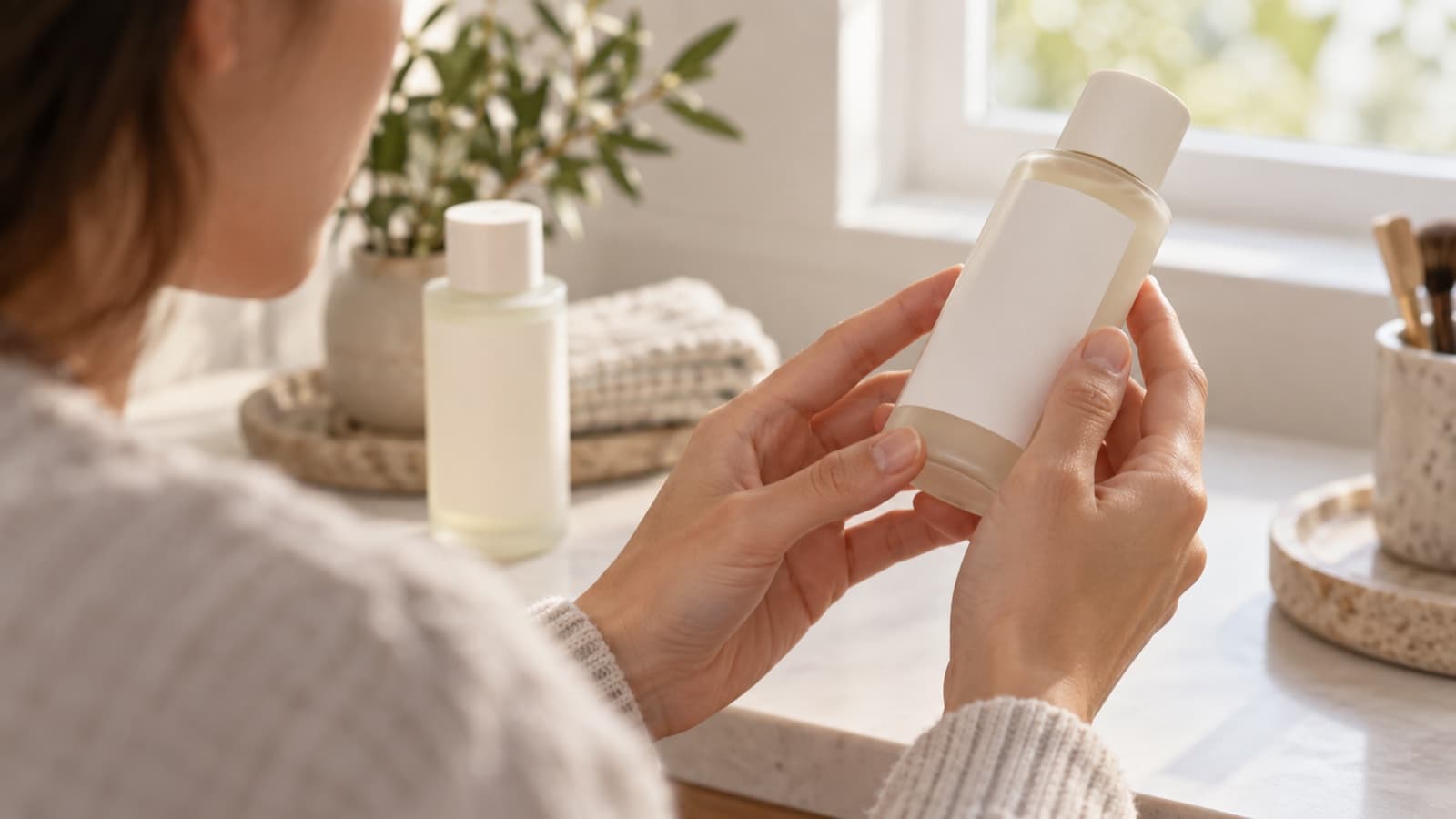
Descriptions such as “cream base” leave you unable to identify the components they cover. This becomes especially important when you need to avoid a specific allergen.
There is an Indian labelling nuance: Rule 34(7) exempts packs containing up to 60 ml of liquid or 30 g of solid and semisolid cosmetics from that ingredient statement requirement. Missing information on a small pack therefore does not automatically establish a violation. It can still leave you without enough information to choose confidently. Read the rule.
Ask the brand: “Please share the complete ingredient list for the version currently sold in India.”
If the answer repeats only the hero ingredients, the information gap remains. Our guide to checking skincare product safety in India covers the wider checks beyond the ingredient panel.
A “fragrance free” claim beside a list containing “parfum” is a discrepancy worth resolving.
Start by checking that the claim and list refer to the same variant and market. A marketplace listing may show an older formula. A packaging photograph may predate a reformulation.
An unfamiliar ingredient name alone is not a contradiction. Before deciding that an advertised ingredient is absent, check its recognised name and ask the brand to identify it in the declaration.
Ask the brand: “Which ingredient list applies to the product I will receive, and how does it support this claim?”
Keep screenshots and, if you already own the product, a photograph of the batch number. The Clean Sheet's Claims Library explains the kinds of evidence different promises call for.
“2% ceramide complex” does not necessarily mean 2% ceramides.
A supplied blend may contain ceramides together with carriers and other ingredients. In a hypothetical formula containing 2% of a blend that is itself 10% ceramides by weight, that blend contributes 0.2% ceramides to the finished product.
This is a disclosure question. The calculation alone cannot tell you whether the moisturiser performs well.
Cosmetics Europe's claim substantiation guidance explains that applying ingredient research to a finished product needs justification, including concentration, delivery system and formulation. This is European industry guidance, not Indian law.
Ask the brand: “Is this the percentage of the active ingredient in the finished formula, or the percentage of the supplied blend?”
If you are paying more because of the advertised number, get that distinction clear first.
A product can suit many people and still be wrong for you.
The FDA's cosmetic allergen guidance identifies fragrance ingredients, certain preservatives and hair dye ingredients among common sources of cosmetic allergy. A confirmed allergy to one of them matters more than reassuring wording on the front.
For fragrance sensitivity, also distinguish “unscented” from “fragrance free”. An unscented product can contain fragrance that masks other smells. The American Academy of Dermatology cautions that botanical ingredients can also introduce fragrance related substances.
Do this: check the full list against the avoidance advice your dermatologist gave you. If the label is unclear, ask the manufacturer before use.
Repeated reactions without an identified cause warrant assessment. Medical patch testing can help identify contact allergens; guessing from internet blacklists may lead you to exclude the wrong ingredients.
A water based face mist containing plant extracts still needs an effective way to control microbial contamination.

Noureddine Halla and colleagues, in their 2018 review “Cosmetics Preservation: A Review on Present Strategies”, describe preservation as a system involving manufacturing, raw material control and suitable testing. Looking for one familiar preservative name cannot evaluate that whole system.
Some formulations can achieve protection through other approaches. ISO 11930 covers preservation testing and microbial risk assessment, including circumstances where products assessed as low risk do not require its preservation efficacy test.
Ask the brand: “How is this product protected against microbial growth, and what testing or risk assessment supports its shelf life?”
A clear explanation is useful. “Natural ingredients keep it safe” leaves the important question unanswered. A brand's refusal to share a full confidential report is not, by itself, proof that no testing exists.
Find the complete list. Match it to the current product. Check personal triggers. Clarify any percentage or claim driving your decision.
When the brand cannot resolve an important question, choosing a more transparent alternative is reasonable. You do not have to prove that a product is dangerous before deciding against buying it.
For help organising the evidence, use The Clean Sheet's Product Review tool. Treat a review as support for your decision, with laboratory testing and individual medical assessment answering questions a public label cannot.
Turn a confusing ingredient list into a clear buying decision.
Review a ProductThis is a consumer guide, not legal or medical advice. Regulatory references are summarised from the published sources above and should be confirmed against the originals. Images courtesy of Unsplash and their photographers, used under the Unsplash License.
No. They may provide clues about the formula's main components, but five is not a universal effectiveness threshold. Read the whole list when checking for a known allergen. Position alone cannot establish whether a claimed benefit is supported.
No. Plant derived ingredients can also cause reactions. The FDA notes that fragrance components can cause sensitivity in some people even when they are safe for most users. Source alone does not predict your response.
It can help identify ingredients and organise questions. An assessment based only on a public list cannot verify undisclosed concentrations, batch contamination or your individual tolerance. Read the explanation behind a flag before treating the score as a buying verdict.
For suitable skincare products, the American Academy of Dermatology recommends testing a small area twice daily for seven to ten days, following normal contact time and directions. This home check is different from diagnostic patch testing and cannot guarantee that no later reaction will occur. Do not use it to challenge a known allergy.
India's regulatory landscape is changing. The Clean Sheet™ certification separates compliant brands from those flying blind. The founding cohort is open now.
Join The Clean Sheet™ community
Science-backed beauty tips, ingredient alerts, and early access. Straight to your WhatsApp.
Join for free →